If you enjoy mathematics and regularly score top grades, you’ve probably heard about a level further maths. But is it worth taking? Is it extremely hard? And do universities really prefer it?
Many students choose it because they love problem-solving. Others take it because they want to study engineering, mathematics, computer science, or physics at top universities. But it’s not just “harder maths” — it’s deeper, more abstract, and more intellectually demanding.
In this guide, we’ll break everything down clearly: the syllabus, exam structure, difficulty level, university value, workload, and how to decide if it’s right for you.
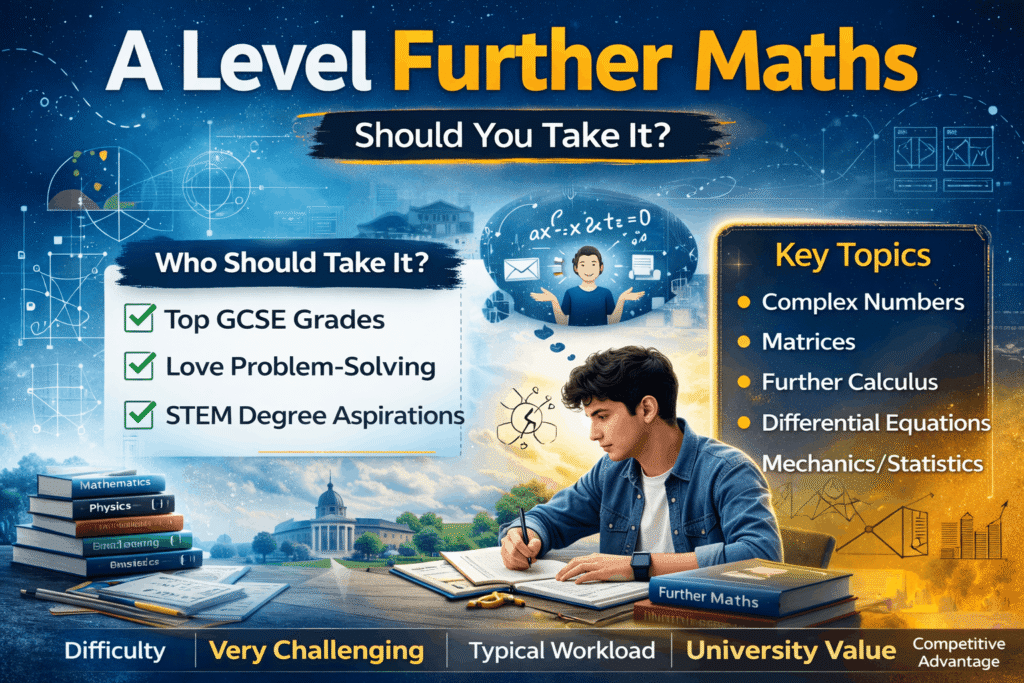
A Level Further Maths is an advanced qualification taken alongside A Level Mathematics. You must take regular A Level Maths first — Further Maths builds on it.
It explores:
Advanced algebra
Complex numbers
Matrices
Further calculus
Differential equations
Advanced mechanics or statistics
Major exam boards offering it include:
AQA
Pearson Edexcel
OCR
Cambridge International
Each board has slightly different optional modules, but the core difficulty level is similar.
This is compulsory.
Topics include:
Complex numbers
Matrices
Further vectors
Polar coordinates
Hyperbolic functions
Advanced proof
These topics feel more abstract than regular maths.
Students choose additional areas such as:
Momentum in two dimensions
Circular motion
Elastic collisions
Probability distributions
Hypothesis testing
Advanced statistical modelling
Algorithms
Linear programming
Graph theory
Your school chooses which modules to offer.
Let’s be honest.
It is one of the hardest A Levels available.
But difficulty depends on:
Your GCSE performance
Your algebra skills
Your interest in maths
Your ability to think abstractly
Students who struggle with algebra in regular maths usually find Further Maths overwhelming.
Students who genuinely enjoy solving challenging problems often find it exciting rather than stressful.
Here’s a simple comparison:
| Feature | A Level Maths | Further Maths |
|---|---|---|
| Algebra depth | Moderate | Very Advanced |
| Calculus | Standard | Advanced |
| Abstract topics | Limited | High |
| Difficulty | Challenging | Very Challenging |
| Required for most degrees | Yes | Sometimes |
Further Maths is not just “more of the same.” It introduces new mathematical worlds.
It suits students who:
Consistently score 8 or 9 at GCSE
Love problem-solving
Want competitive STEM degrees
Enjoy algebra more than statistics
Example:
A student aiming for mathematics at a top UK university will benefit significantly from Further Maths.
But a student planning to study medicine usually doesn’t need it.
Top UK universities such as:
University of Oxford
University of Cambridge
Imperial College London
Often recommend or expect Further Maths for degrees like:
Mathematics
Engineering
Physics
Computer Science
However, it’s not mandatory everywhere.
Some universities clearly state:
“If Further Maths is offered at your school, we expect applicants for maths-related courses to take it.”
This is important.
No qualification guarantees admission.
Universities care about:
Grades
Personal statement
Admissions tests
Interviews
Further Maths strengthens your application, but it does not replace overall academic performance.
You’re effectively studying two maths A Levels at once.
Expect:
More homework
Harder problem sheets
Longer revision sessions
Time management becomes critical.
Many students underestimate the workload.
Complex numbers and matrices feel strange at first.
You must be comfortable thinking beyond “normal” numbers.
Teachers move quickly.
If you fall behind, catching up is difficult.
Questions are multi-step and require deep understanding.
Memorizing formulas won’t help much.
Yes — if:
You enjoy maths deeply
You want competitive STEM courses
You can handle academic pressure
No — if:
You already feel stretched with A Level Maths
You dislike abstract topics
You need more balance in your subject choices
Yes — if:
You enjoy maths deeply
You want competitive STEM courses
You can handle academic pressure
No — if:
You already feel stretched with A Level Maths
You dislike abstract topics
You need more balance in your subject choices
Further Maths develops:
Analytical reasoning
Logical thinking
Advanced problem solving
Careers that value it include:
Engineering
Finance
Data Science
Actuarial Science
Software Development
It signals strong mathematical ability.
Students often compare this with IB HL Maths.
Further Maths:
More depth in algebra
Heavy abstraction
Exam-focused
IB HL Maths:
Broader skill set
Includes internal assessments
Research component
Both are rigorous.
The better choice depends on curriculum preference.
Ask yourself:
Do I enjoy challenging puzzles?
Am I consistently strong in maths?
Do I want a maths-heavy degree?
Speak to:
Your maths teacher
University advisors
Current Further Maths students
Choosing it for prestige alone is not a good reason.
Choose it because you genuinely enjoy mathematical thinking.
A Level Further Maths is demanding, rewarding, and highly respected.
It opens doors for competitive STEM degrees and strengthens analytical skills. But it requires dedication, consistency, and genuine interest in mathematics.
If you love maths and want to push yourself academically, it can be one of the most powerful A Levels you take.
If you’re unsure whether it fits your goals, seek academic guidance early. The right decision can shape your university pathway and future career direction.
Yes. It is significantly more advanced and abstract.
Not always, but top universities strongly recommend it.
No. You must take A Level Maths alongside it.
Yes. Universities worldwide recognize it as a strong academic qualification.
Around 6–8 hours outside class is common, depending on ability.
It’s difficult but possible with strong discipline and support materials.

IB Demystified is a trusted online learning platform led by certified IB examiners and educators.
© 2026 IB Demystified LTD ALL RIGHTS RESERVED. Powered by AfiaDigital
WhatsApp us
I am a
Teachers log in with the details IB Demystified sent them. No account yet? Please contact us.