GCSE (General Certificate of Secondary Education) is a UK-based qualification taken by students typically aged 14–16 in England, Wales, and Northern Ireland.
Designed mainly for UK students
Regulated by Ofqual
Exam boards include AQA, Edexcel, OCR
Focus on UK curriculum standards
Grades awarded from 9 to 1 (9 being the highest)
GCSEs are commonly required for progression to A-Levels, vocational qualifications, or further education within the UK.
IGCSE (International General Certificate of Secondary Education) is an internationally recognized qualification designed for students worldwide.
Offered in over 150 countries
Exam boards include Cambridge (CAIE) and Edexcel
Flexible curriculum for international students
Less coursework (more exam-based in many subjects)
Grading often from A to G* or 9–1
IGCSE is especially popular in international schools, homeschooling, and among students planning to study abroad.
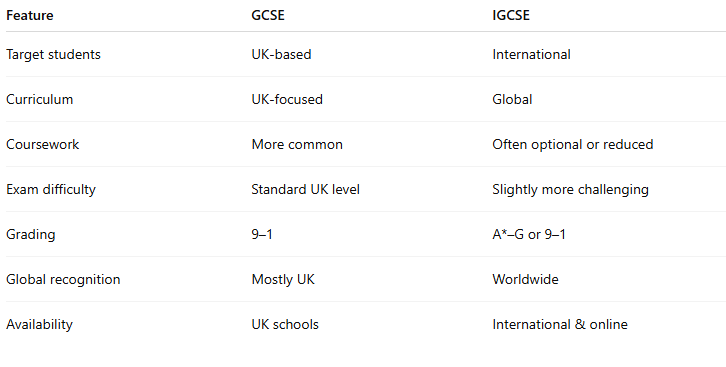
One major difference between GCSE and IGCSE lies in the curriculum depth.
GCSE content is aligned closely with the UK education system.
IGCSE syllabi are often broader and more flexible, allowing schools to adapt content to international contexts.
For example:
IGCSE Science often includes deeper conceptual understanding.
GCSE English focuses more on UK texts, while IGCSE uses global literature.
Combination of coursework + final exams
More controlled assessments
Greater emphasis on internal evaluation
Mostly final exams
Less coursework in many subjects
Favors students strong in exam performance
👉 This makes IGCSE ideal for students who perform better under exam-based evaluation.
This is a common question.
✔ IGCSE is often considered slightly harder, especially in subjects like:
Mathematics
Sciences
English
However, “harder” also depends on:
Student learning style
Subject choice
Exam board
A motivated student with strong study habits can excel in either system.
There is no universal “better” option. The best choice depends on your goals.
You plan to study in the UK
You prefer coursework-based assessment
You attend a UK state school
You study in an international school
You plan to move countries or study abroad
You prefer exam-focused assessment
You want global university recognition
Yes ✅
Top universities in the UK, US, Canada, Australia, and Europe accept both GCSE and IGCSE equally when combined with A-Levels, IB, or equivalent qualifications.
Universities focus more on:
Grades achieved
Subject rigor
Overall academic performance
Yes, but it requires planning.
Switching early (Year 9–10) is easier
Switching later may require syllabus alignment
Online tutoring can help bridge gaps
Many students successfully transition with the support of experienced tutors.
For international students, IGCSE is usually the better option because:
Curriculum is globally relevant
Exams are recognized worldwide
English language support is built in
This is why most international schools offer IGCSE instead of GCSE.
To summarize:
GCSE → Best for UK-based students
IGCSE → Best for international and globally mobile students
Both qualifications are rigorous, respected, and excellent preparation for higher education.
At IB Demystified, we provide:
Expert IGCSE tutors
Online GCSE Maths & Science tutoring
Personalized study plans
Exam-focused strategies
👉 Book a free consultation to find the right path for your academic success.


IB Demystified is a trusted online learning platform led by certified IB examiners and educators.
© 2026 IB Demystified LTD ALL RIGHTS RESERVED. Powered by AfiaDigital
WhatsApp us
I am a
Teachers log in with the details IB Demystified sent them. No account yet? Please contact us.