If you are starting the International Baccalaureate Diploma Programme, one question comes up very quickly: how IB score is calculated.
Understanding the IB scoring system can feel confusing at first. Students hear things like “45 points,” “core points,” “HL and SL grades,” and “TOK and EE matrix.” Without a clear explanation, it can be hard to understand what actually determines your final score.
In this guide, we will explain how IB scores are calculated step-by-step in a simple and clear way. Whether you are a student preparing for exams, a parent trying to understand the system, or a teacher helping students plan their goals, this article will break everything down.
By the end, you will understand:
The IB 45-point scoring system
How subject grades are calculated
How TOK and Extended Essay add extra points
The minimum requirements to pass the IB Diploma
Real examples of IB score calculations
Let’s start with the basics.
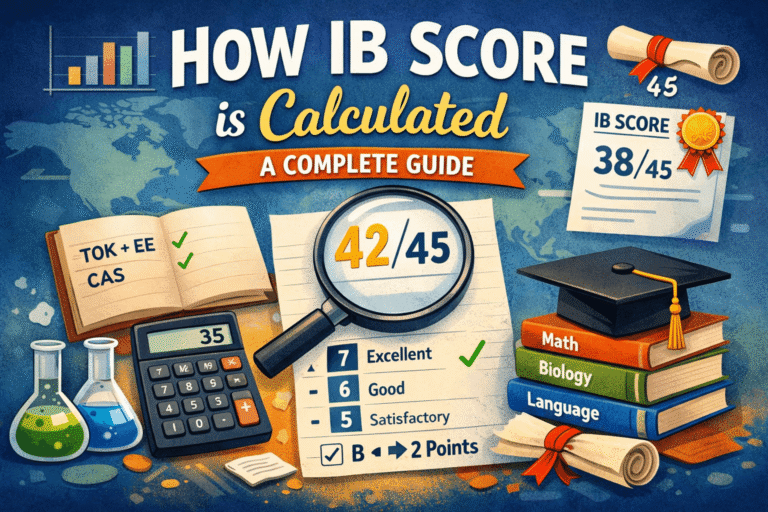
The IB Diploma Programme uses a maximum score of 45 points.
These points come from two main parts:
| Component | Maximum Points |
|---|---|
| 6 Subjects | 42 points |
| Core (TOK + EE) | 3 points |
| Total | 45 points |
So when someone says a student got 38 in IB, it means they scored 38 out of 45.
Students take six subjects, and each subject is graded on a scale of 1 to 7.
7 = Excellent
6 = Very good
5 = Good
4 = Satisfactory
3 = Mediocre
2 = Poor
1 = Very poor
If a student scores 7 in all six subjects, they would get:
7 × 6 = 42 points
Then they can earn up to 3 extra points from the IB Core.
Every IB student studies six subjects from different groups.
Typical IB subject groups include:
Studies in Language and Literature
Language Acquisition
Individuals and Societies
Sciences
Mathematics
The Arts (or another subject)
Students also choose Higher Level (HL) and Standard Level (SL) subjects.
Most students take:
3 Higher Level (HL) subjects
3 Standard Level (SL) subjects
HL subjects are studied in more depth and usually have more teaching hours.
However, HL and SL are graded on the same 1-7 scale.
To understand how IB score is calculated, we must first understand how individual subject grades work.
Each subject is assessed using two main components:
These are assignments graded by your teacher and moderated by IB.
Examples include:
Science experiments
Math explorations
Language oral exams
Research essays
Internal assessments usually count 20–30% of the final grade.
These are the final IB exams graded by external examiners.
Examples:
Paper 1
Paper 2
Paper 3 (for some subjects)
External exams typically count 70–80% of the final grade.
Let’s say a student studies IB Economics HL.
| Component | Weight | Score |
|---|---|---|
| Internal Assessment | 20% | 6 |
| Exam Papers | 80% | 5 |
The combined score may result in a final grade of 5 or 6, depending on the IB grade boundaries for that year.
IB sets grade boundaries every exam session, which means scores can slightly change each year.
Apart from the six subjects, IB students must complete the IB Core.
The core has three elements:
Theory of Knowledge (TOK)
Extended Essay (EE)
Creativity, Activity, Service (CAS)
However, only TOK and EE affect your IB score.
CAS is required to pass the diploma, but it does not give points.
TOK is a course about how knowledge works.
Students explore questions such as:
How do we know what is true?
Can knowledge be biased?
How does culture influence knowledge?
TOK assessment includes:
TOK Essay
TOK Exhibition
Students receive grades from A to E.
The Extended Essay is a 4,000-word independent research paper.
Students choose a topic related to one of their IB subjects.
Examples include:
Physics research topic
Economics policy analysis
Literature analysis
Like TOK, the Extended Essay is graded A to E.
TOK and Extended Essay are combined using the IB Core Points Matrix.
Students can earn 0 to 3 extra points.
| TOK | EE | Core Points |
|---|---|---|
| A | A | 3 |
| A | B | 3 |
| B | B | 2 |
| B | C | 2 |
| C | C | 1 |
| D | D | 0 |
However, if a student gets an E in either TOK or EE, they fail the diploma.
Understanding how IB score is calculated is important, but students also need to know the minimum passing rules.
To receive the IB Diploma, students must:
✔ Score at least 24 points total
✔ Complete CAS requirements
✔ Avoid receiving an E in TOK or EE
There are also additional conditions:
Minimum 12 points in HL subjects
Minimum 9 points in SL subjects
No more than two grade 2s
No grade 1
Failing these conditions may result in not receiving the diploma, even if the score is above 24.
IB scores vary depending on university goals.
Here is a general guideline:
| IB Score | Meaning |
|---|---|
| 24–28 | Pass / average |
| 29–34 | Good |
| 35–38 | Very strong |
| 39–42 | Excellent |
| 43–45 | Exceptional |
Top universities often expect:
38–42 points
However, admission requirements depend on the country and program.
Universities around the world understand the IB scoring system.
For example:
Many UK universities give offers like:
36 points with 6,6,6 in HL
US universities evaluate:
Overall IB score
HL subjects
Course rigor
Some universities convert IB scores into local grading systems.
Understanding how IB score is calculated can help students plan better.
Here are practical strategies.
IAs can significantly boost your grade.
Start early and get teacher feedback.
Pick HL subjects based on:
Your strengths
University goals
Avoid choosing HL subjects just because friends do.
The EE takes months to complete.
Students who start early often get higher grades.
Each IB subject has specific exam strategies.
Practice past papers regularly.
Many students underestimate TOK.
But strong TOK results can add valuable core points.
Students who understand the scoring system can:
Set realistic target scores
Plan HL and SL choices wisely
Improve IA performance
Reduce stress during exams
In other words, knowing how IB score is calculated helps students study smarter, not just harder.
The IB scoring system may seem complicated at first, but once you understand the structure, it becomes much clearer.
Here are the key takeaways:
The IB Diploma is scored out of 45 points
Six subjects contribute up to 42 points
TOK and Extended Essay add up to 3 core points
Students must score at least 24 points to pass
Universities often expect 35+ points for competitive programs
Understanding how IB score is calculated helps students set goals, track progress, and plan their IB journey effectively.
If you want to improve your IB grades or prepare for exams with expert guidance, explore our IB tutoring programs at ibdemystified.com, where experienced IB tutors help students master subjects, internal assessments, and exam strategies.
The highest possible IB score is 45 points.
This includes:
42 points from six subjects
3 core points from TOK and the Extended Essay
Very few students worldwide achieve a perfect 45 each year.
Students must score at least 24 points to receive the IB Diploma.
They must also meet other requirements like:
Completing CAS
Avoiding an E in TOK or EE
Meeting HL and SL minimum scores.
No.
Both HL and SL subjects are graded on the same 1-7 scale.
However, HL courses are more difficult and more detailed.
TOK and EE together can provide up to 3 additional points.
These points are determined using the IB core points matrix.
No.
CAS (Creativity, Activity, Service) does not give any points, but it is mandatory to complete to receive the diploma.
Top universities often expect 38–42 points.
However, requirements vary depending on the course and university.

IB Demystified is a trusted online learning platform led by certified IB examiners and educators.
© 2026 IB Demystified LTD ALL RIGHTS RESERVED. Powered by AfiaDigital
WhatsApp us
I am a
Teachers log in with the details IB Demystified sent them. No account yet? Please contact us.