
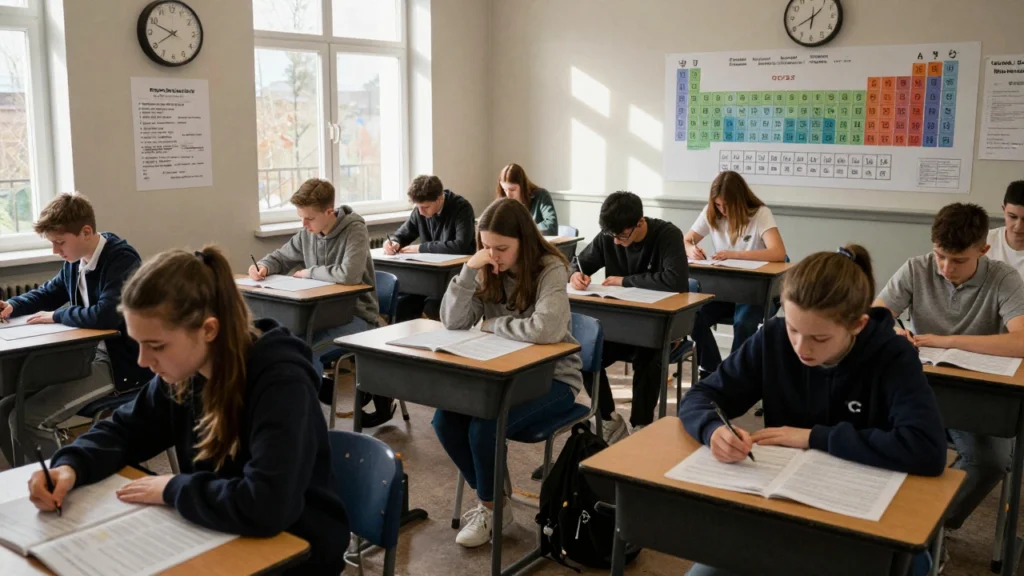
The GCSE qualification (General Certificate of Secondary Education) is a UK-based academic program usually taken by students aged 14–16. It is widely offered in the UK and recognized internationally.
Governed by UK exam boards (AQA, Edexcel, OCR)
Focus on national education standards
Includes exams and, in some subjects, GCSE coursework
Designed mainly for UK students
The International General Certificate of Secondary Education (IGCSE) is the international version of the GCSE. It is designed for students studying outside the UK or in international schools.
More globally focused content
Less UK-specific context
Greater emphasis on understanding and application
Widely accepted by universities worldwide
The short answer: IGCSEs are often considered harder than GCSEs, but it depends on the subject and the student.
Here are the main reasons:
More content depth in many IGCSE subjects
Greater focus on conceptual understanding
Fewer opportunities for coursework compared to GCSEs
Exams often require analytical and problem-solving skills
That said, some students find GCSEs challenging due to coursework deadlines and exam pressure.

Structured around UK national standards
More guidance and structured learning
Coursework included in selected subjects
Topics often taught step-by-step
Broader and more flexible
International examples and contexts
Strong focus on independent learning
Designed for diverse student backgrounds
English Language & Literature
Mathematics
Biology, Chemistry, Physics
History
Geography
Computer Science
Art & Design
Business Studies
IGCSE Mathematics
IGCSE Sciences
IGCSE English
Economics
Global Perspectives
Environmental Management
ICT
Both programs offer a wide range of subjects, but IGCSE subjects often include more internationally relevant options.
Counts toward final grades in some subjects
Requires consistent work throughout the year
Can reduce pressure on final exams
GCSEs may include coursework + exams
IGCSEs rely more on final written exams
IGCSE assessments often test application and reasoning
The GCSE grading system uses a 9–1 scale:
9 = Highest grade
4 = Standard pass
5 = Strong pass
The GCSE pass rate is generally high, especially for core subjects, due to structured assessment methods and coursework options.
IGCSE grading depends on the exam board but often follows A*–G or 9–1 systems.
Focus on exam techniques and mark schemes
Revision guides aligned with UK exam boards
Coursework planning is essential
Requires deeper understanding of concepts
More independent study
Practice with past papers is crucial
Both qualifications benefit from expert guidance and consistent revision.
There is no “better” option — only the right fit.
Choose GCSEs if:
You are studying in the UK
You prefer structured learning and coursework
You want strong national alignment
Choose IGCSEs if:
You attend an international school
You plan to study abroad
You prefer exam-focused assessment and global content
Yes, IGCSEs are generally considered harder than GCSEs, mainly due to:
Broader curriculum
Higher exam difficulty
Greater emphasis on independent learning
However, success in either program depends on preparation, subject choice, and academic support.
IB Demystified is a trusted online learning platform led by certified IB examiners and educators.
© 2026 IB Demystified LTD
ALL RIGHTS RESERVED.
Powered by AfiaDigital
WhatsApp us