
If you’ve ever tried to remember a phone number while someone is talking to you, you’ve used your working memory. The Baddeley and Hitch working memory model explains how our short-term thinking system actually works. Instead of seeing memory as one single store, this model shows that different parts of the brain handle different tasks at the same time.
For IB and A-Level psychology students, this model is essential because it explains everyday mental processes like reading, problem solving, and multitasking.
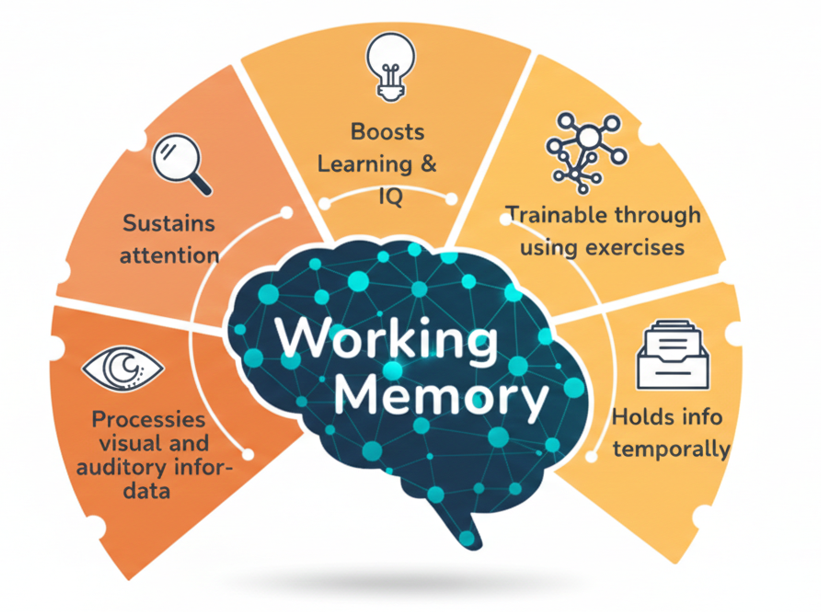
Working memory is the system that:
Holds information temporarily
Allows us to think, reason, and understand
Helps us combine new and old information
It is not just storage. It is active processing.
Example:
When solving a math problem, you must remember numbers, follow steps, and think about rules at the same time. That is working memory in action.
Before this theory, psychologists used the Multi-Store Model of Memory, which described short-term memory as a single unit. But researchers noticed problems:
People could do two tasks at once if they used different types of processing
Brain injury patients lost some memory abilities but not others
Language tasks and visual tasks did not always interfere
This suggested short-term memory was not one single system.
Baddeley and Hitch proposed that working memory has multiple components, each with a different role.
Central Executive
Phonological Loop
Visuospatial Sketchpad
Episodic Buffer (added in 2000)
Baddeley and Hitch proposed that working memory has multiple components, each with a different role.
Central Executive
Phonological Loop
Visuospatial Sketchpad
Episodic Buffer (added in 2000)
The central executive:
Directs attention
Decides what to focus on
Coordinates other systems
Switches between tasks
It does not store information. It controls processing.
You are reading a book while ignoring background noise. The central executive helps you focus on reading instead of listening.
It is hard to study scientifically because it is an abstract control system, not a physical storage unit.
This part deals with verbal and auditory information.
It has two parts:
Holds spoken words you hear
Information fades after about 2 seconds
Repeats words to keep them in memory
Like silently repeating a number
You repeat a phone number in your head until you write it down.
Word Length Effect:
People remember short words (dog, pen) better than long words (university, refrigerator).
Why? Long words take longer to rehearse.
This part handles:
Images
Shapes
Spatial layout
Movement
It helps us “see” things in our mind.
When someone gives you directions like, “Turn left after the big tree,” you imagine the road. That uses the visuospatial sketchpad.
Research suggests it may include:
Visual cache (stores visual details)
Inner scribe (spatial and movement information)
Brain scans show different brain areas activate for visual tasks versus verbal tasks.
Added later by Baddeley (2000).
Links information from different systems
Connects working memory to long-term memory
Forms integrated episodes
You remember a story from class, including the teacher’s voice, slides, and your own thoughts. The episodic buffer combines all these.
Imagine you are watching a movie with subtitles:
Visuospatial sketchpad → processes images
Phonological loop → reads dialogue
Episodic buffer → combines picture + sound + meaning
Central executive → controls attention
This shows working memory is multi-component.
Participants performed:
A reasoning task
While remembering numbers
Even when memory load increased, reasoning performance did not collapse. This suggested:
👉 Short-term memory has separate subsystems
👉 Not one single limited store
Dual-task experiments show:
Visual + verbal tasks can be done together
Two visual tasks interfere with each other
This supports separate subsystems.
Neuroimaging shows different brain areas for verbal and visual tasks.
The model explains:
Multitasking
Language learning
Reading comprehension
Navigation
We know it controls attention, but how exactly it works is unclear.
Some psychologists believe memory processes are more complex than four boxes.
The model does not explain differences in memory skills between individuals.
Working memory capacity affects:
Reading ability
Math performance
Problem solving
Note-taking
Students with stronger working memory often perform better academically.
Teachers can improve learning by:
Using visuals + spoken explanations
Breaking information into chunks
Avoiding overload
Encouraging rehearsal
This aligns with how working memory systems function.
| Feature | Multi-Store Model | Working Memory Model |
|---|---|---|
| Short-term memory | One unit | Multiple components |
| Focus | Storage | Processing + storage |
| Explains multitasking | No | Yes |
| Visual vs verbal | Not separated | Clearly separated |
This topic is common in:
Cognitive approach
Memory studies
Research methods questions
Students must know:
Structure of the model
Research evidence
Strengths and weaknesses
Real-life applications
The Baddeley and Hitch working memory model changed how psychologists understand short-term thinking. It shows that working memory is not one simple store but a system of interacting components that process sound, images, attention, and experience together.
For students, this model explains how we read, solve problems, and learn new information every day. Understanding it makes both psychology exams and real-life learning easier.
IB Demystified is a trusted online learning platform led by certified IB examiners and educators.
© 2026 IB Demystified LTD
ALL RIGHTS RESERVED.
Powered by AfiaDigital
WhatsApp us