
Choosing between ib vs a levels can feel overwhelming. Students worry about workload. Parents worry about university admissions. Teachers want to guide students toward the right academic fit.
Both the International Baccalaureate (IB) and Cambridge Assessment International Education A Levels are respected worldwide. But they are very different in structure, learning style, and pressure.
In this guide, we’ll clearly compare everything — subjects, difficulty, university recognition, stress levels, and future opportunities — so you can confidently decide what suits you best.
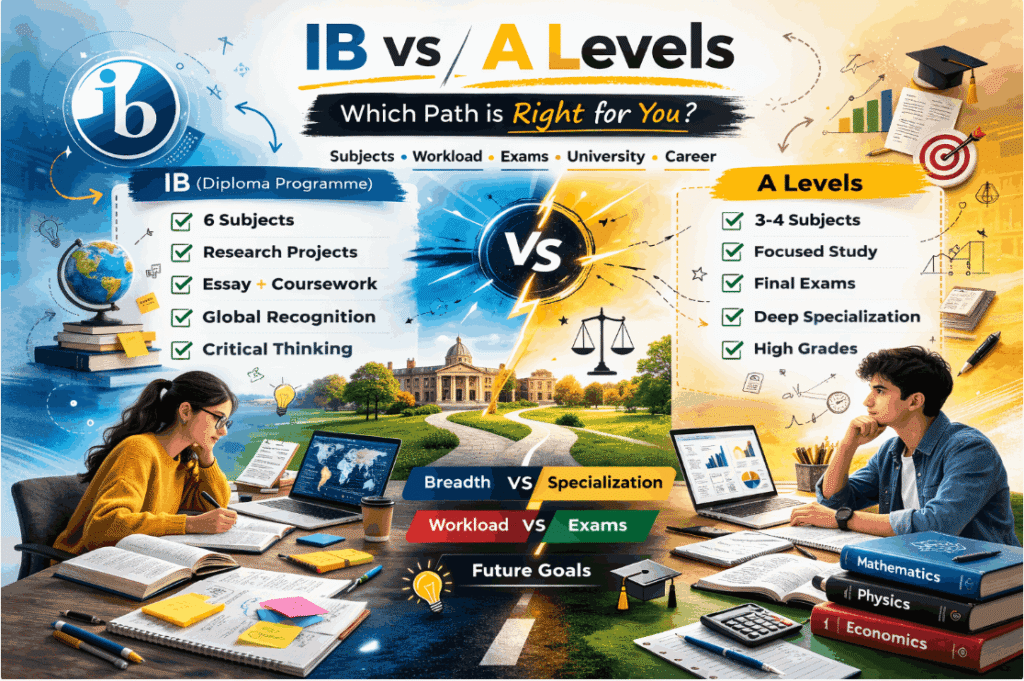
The IB Diploma Programme (IBDP) is a two-year international qualification for students aged 16–19.
Students study:
6 subjects (3 Higher Level, 3 Standard Level)
Extended Essay (4,000-word research paper)
Theory of Knowledge (TOK)
CAS (Creativity, Activity, Service)
It focuses on:
Critical thinking
Research skills
Global awareness
Balanced subject selection
IB students must take:
A language
A science
Mathematics
Humanities
Arts or elective
It’s broad and holistic.
A Levels are subject-based qualifications mainly offered in the UK and internationally.
Students typically choose:
3 subjects (sometimes 4 in Year 12)
No compulsory extra core components like TOK or CAS
Exams mainly at the end of two years (depending on exam board)
A Levels focus on:
Specialization
Deep subject knowledge
Exam performance
You choose only the subjects you enjoy or need for university.
In IB, even if you love science, you must still study:
A language
A humanities subject
Mathematics
This builds versatility.
Example:
A student who wants to study medicine still studies English and History alongside Biology and Chemistry.
With A Levels, you choose only what you need.
Example:
Future engineering student:
Mathematics
Physics
Further Mathematics
That’s it. No essays in unrelated subjects.
Best for: Students who already know their career path.
This is one of the biggest differences in ib vs a levels discussions online.
IB includes:
Internal assessments
Research papers
Presentations
CAS reflections
Extended Essay
Final exams
It’s continuous assessment.
Many students say IB feels intense because:
Deadlines overlap
Multiple subjects require coursework
Time management is critical
A Levels are:
More exam-focused
Less coursework-heavy (depends on subject)
Pressure builds closer to final exams.
Students often say:
Less daily pressure
But higher exam pressure at the end
Combination of:
Internal Assessments (IAs)
Essays
Oral exams
Projects
Final exams
Marks are spread across components.
This reduces “all-or-nothing” risk.
Mostly final exams.
If you perform poorly on exam day, it strongly affects your grade.
This suits students who:
Perform well under exam conditions
Prefer fewer coursework tasks
Both qualifications are widely respected.
Top universities like:
University of Oxford
University of Cambridge
Imperial College London
Accept both IB and A Levels equally.
Offers are structured differently:
IB: 36–40 points typical competitive range
A Levels: AAA or A*AA typical
US institutions like:
Harvard University
Stanford University
Appreciate IB because of:
Research skills
Essay writing
Critical thinking
But A Levels are equally accepted.
There is no universal “better.”
Universities care about:
Grades
Subject relevance
Personal statement
Extracurriculars
Not just the qualification name.
IB may suit students who:
Enjoy writing essays
Like research projects
Are strong in time management
Want a balanced academic profile
Haven’t fully decided on a career
Ali wants to study international relations but also enjoys biology.
IB allows him to:
Study sciences
Study humanities
Develop research skills
It keeps options open.
A Levels may suit students who:
Are very clear about career goals
Prefer deep focus
Dislike compulsory subjects
Prefer exam-based systems
Sara wants to study pure mathematics.
A Levels let her:
Focus heavily on Maths
Add Further Maths
Avoid unrelated essay subjects
Perfect specialization.
This is one of the most searched questions.
The honest answer: They are hard in different ways.
IB is harder because:
More components
Continuous deadlines
Broader subjects
A Levels are harder because:
Deep content mastery
Heavy final exams
High grade boundaries in competitive subjects
Difficulty depends on:
Learning style
Strengths
Study habits
Research writing
Academic referencing
Presentation skills
Independent thinking
Many IB graduates say university feels smoother because they’ve already written research essays.
Subject expertise
Analytical problem solving
Strong exam technique
Students often feel academically strong in their chosen discipline.
Online forums show mixed opinions.
Some IB students report:
Burnout during IA season
Stress managing multiple subjects
Some A Level students report:
High pressure before final exams
Anxiety around grade boundaries
The key factor isn’t the program — it’s:
School support
Personal time management
Academic guidance
If you plan to study abroad in multiple countries:
IB may feel slightly more globally recognized.
But A Levels are accepted worldwide in:
UK
Australia
Canada
Many US institutions
Both are strong international passports.
IB keeps doors open longer.
A Levels narrow focus earlier.
If you:
Love multiple subjects → IB
Love one field deeply → A Levels
IB is not offered everywhere.
A Levels are more widely available internationally.
Some schools charge more for IB due to:
Extra administration
Smaller class sizes
IB fees
Always check availability in your region.
| Feature | IB | A Levels |
|---|---|---|
| Subjects | 6 required | 3–4 chosen |
| Coursework | High | Medium–Low |
| Exams | Mixed | Mostly final |
| Specialization | Low | High |
| University Recognition | Excellent | Excellent |
| Flexibility | Broad | Focused |
| Research Component | Yes (EE) | No |
False. Grades matter more than program type.
Not necessarily. They are just different.
Both programs attract strong students.
Ask yourself:
Do I enjoy essay writing?
Can I manage multiple deadlines?
Am I certain about my future degree?
Do I perform better in exams or coursework?
Talk to:
Teachers
University advisors
Current IB/A Level students
The right choice is personal — not prestige-based.
The debate around ib vs a levels will continue because both are excellent qualifications.
Choose IB if you want:
Breadth
Research skills
Academic balance
Choose A Levels if you want:
Deep specialization
Focused study
Clear subject direction
There is no “superior” path — only the path that fits you.
If you’re still unsure, speaking to experienced academic advisors can make all the difference. The right guidance helps students not only choose the right program but succeed in it.
They are difficult in different ways. IB has more coursework and subjects. A Levels require deep mastery in fewer subjects.
Top universities accept both equally. They focus on grades and subject relevance.
Yes. UK universities fully recognize the IB Diploma.
Yes. A Levels are widely accepted by US institutions.
Both IB and A Levels work for medicine. What matters most is taking Biology and Chemistry at a high level.
IB may be better because it keeps more subject areas open.
IB Demystified is a trusted online learning platform led by certified IB examiners and educators.
© 2026 IB Demystified LTD
ALL RIGHTS RESERVED.
Powered by AfiaDigital
WhatsApp us