
If you’ve ever wondered why sand seems to “move” along a beach, the answer is longshore drift. This coastal process explains how waves transport sediment sideways along the shore, shaping coastlines over time. Understanding longshore drift is important for geography students, especially in IB and A Level, because it links directly to coastal erosion, deposition, and human coastal management.
Let’s break it down in a simple, visual way.
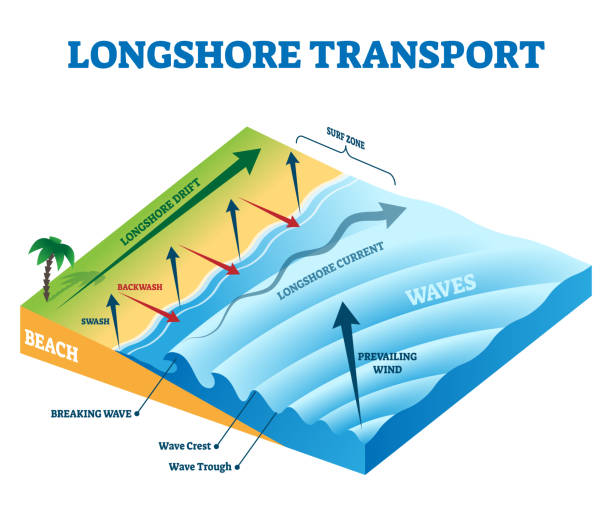
Longshore drift definition: Longshore drift is the movement of sediment (like sand and pebbles) along a coastline caused by waves approaching the shore at an angle.
In geography terms, it’s a transportation process that redistributes beach material. Over time, it can build beaches in some places and remove them from others.
So when someone asks, “What is longshore drift?”
Think: waves hit at an angle → material moves sideways.
Longshore drift happens because of two main wave movements: swash and backwash.
Swash is the water that rushes up the beach after a wave breaks. Because waves usually approach the shore at an angle (due to prevailing wind), the swash moves material diagonally.
Backwash is the water that flows back down the beach under gravity. This movement goes straight down, at a 90° angle to the shore.
Waves don’t always travel straight toward the shore. Their direction depends on:
The prevailing wind is the main wind direction in an area. It controls the angle at which waves hit the coastline.
If wind blows diagonally toward land, waves will also approach diagonally.
Fetch is the distance wind travels over open water. The longer the fetch, the more energy waves gain.
Long fetch = bigger, stronger waves
Stronger waves = more sediment movement
So fetch affects how powerful longshore drift is.
Longshore drift transports:
Sand
Shingle
Small pebbles
Sediment from eroded cliffs
Heavier materials move slowly. Lighter sand travels further.
Longshore drift plays a big role in shaping coastlines.
Sediment may be removed from one area, causing:
Narrower beaches
Increased cliff erosion
Greater flood risk
The transported material is deposited elsewhere, forming features like:
Spits
Bars
Tombolos
Wider beaches
So longshore drift doesn’t destroy material — it redistributes it.
On many UK coasts, sediment moves from west to east due to prevailing south-westerly winds. This means beaches in the west lose material while eastern areas gain it.
This is why coastal management in one location can affect another.
Why Is Longshore Drift Important for Students?
Students often:
Confuse erosion with transportation
Forget the zig-zag movement
Ignore the role of prevailing wind
Think backwash moves at an angle (it doesn’t)
Remember: swash at angle, backwash straight.
| Term | Meaning |
|---|---|
| Swash | Water moving up the beach |
| Backwash | Water flowing back down |
| Prevailing wind | Main wind direction |
| Fetch | Distance wind travels over water |
| Sediment transport | Movement of material |
Longshore drift is a simple but powerful coastal process. Waves approaching at an angle create a zig-zag movement of sand and sediment along the shoreline. This leads to erosion in some places and deposition in others, shaping the coast over time.
Understanding this process helps students explain beach formation, coastal management, and shoreline change — key topics in geography courses.
What is longshore drift in simple words?
What causes longshore drift?
Swash moves sediment up at an angle, backwash pulls it down straight.
A longer fetch creates stronger waves, increasing sediment movement.
Is longshore drift erosion or transportation?
Is longshore drift erosion or transportation?
It explains coastal landforms, erosion patterns, and management strategies.
IB Demystified is a trusted online learning platform led by certified IB examiners and educators.
© 2026 IB Demystified LTD
ALL RIGHTS RESERVED.
Powered by AfiaDigital
WhatsApp us