
In IB Computer Science, students are expected to understand how computer systems manage multiple tasks efficiently. Two key concepts that often confuse students are parallel processing and concurrent processing.
Although these terms are sometimes used interchangeably, they describe different approaches to program execution. Understanding the difference between concurrent and parallel processing is essential for exams, internal assessments (IA), and real-world computing knowledge.

Parallel concurrent processing refers to how a computer system:
Manages multiple tasks at the same time (concurrency)
Executes multiple operations simultaneously using hardware resources (parallelism)
In IB terms:
Concurrency focuses on task management
Parallelism focuses on task execution
Modern systems often use both together.
Concurrent processing occurs when multiple tasks are in progress during the same time period, even if only one task is executed at a specific moment.
This is common in:
Single-core processors
Operating systems
Multitasking environments
A computer running:
A music player
A web browser
A background download
The CPU switches rapidly between tasks.
This is concurrent processing, not parallel execution.
Parallel processing occurs when multiple tasks are executed at the exact same time, using:
Multiple CPU cores
Multiple processors
Distributed systems
A quad-core processor running:
Four calculations simultaneously
Each on a separate core
This comparison directly answers:
concurrent processing vs parallel processing
parallel vs concurrent processing
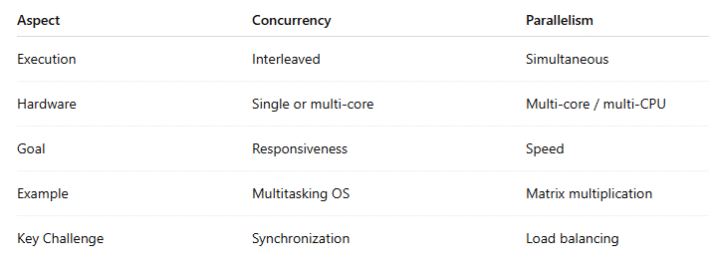
📌 Concurrency is about structure
📌 Parallelism is about execution
This question is commonly tested conceptually.
Concurrency: Multiple tasks make progress together
Parallelism: Multiple tasks run at the same instant
Threads share memory
Used for concurrent processing
Can be parallel on multi-core systems
A web server handling multiple user requests using threads.
Race conditions
Deadlocks
Data inconsistency
This is a great evaluation-style question.
❌ Parallel processing is not automatically safer.
Both parallel and concurrent systems can suffer from:
Shared resource conflicts
Synchronization errors
✔ Safety depends on:
Program design
Resource control
Synchronization techniques
This is excellent material for IB IA evaluation marks.
You can mention these concepts in:
System design
Justification of algorithm choices
Performance evaluation
Example:
“The system uses concurrent processing to handle user input while performing background data validation.”
Understanding parallel concurrent processing helps IB students:
Answer theory questions clearly
Avoid conceptual confusion in exams
Write stronger IAs
Understand modern computing systems
❌ Saying concurrency always means parallel
❌ Ignoring hardware requirements
❌ Using real-world examples without explanation
❌ Confusing threads with processes
Frequently asked interview questions:
Difference between concurrency and parallelism
Thread vs process
Deadlock vs race condition
When to use parallel processing
CPU-bound vs IO-bound tasks
Strong answers focus on use cases, not definitions.
IB Demystified is a trusted online learning platform led by certified IB examiners and educators.
© 2026 IB Demystified LTD
ALL RIGHTS RESERVED.
Powered by AfiaDigital
WhatsApp us